
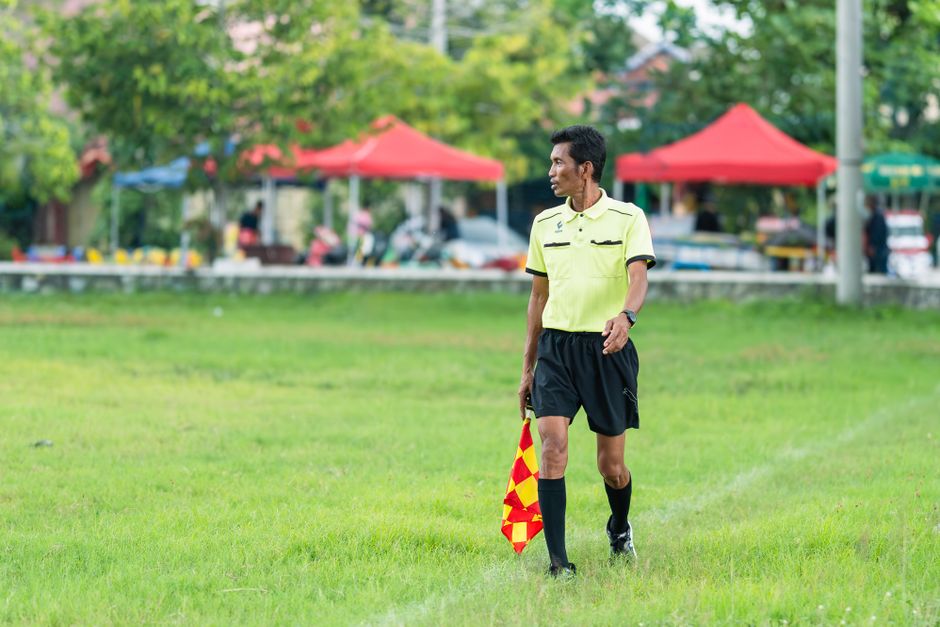
A forward can be standing behind the defensive line without committing an offence. The whistle comes only when that player becomes involved in the play from an illegal position. That distinction explains why the soccer offside rule often looks more complicated than it is.
What does offside mean in soccer?
A player is in an offside position if, at the moment a teammate plays or touches the ball, the player is nearer to the opponents’ goal line than both the ball and the second-last opponent.
Only certain parts of the body count. The head, body and feet can place a player in an offside position, but the hands and arms do not. For this purpose, the boundary is the top of the armpit.
The second-last opponent is usually the last outfield defender because the goalkeeper is often the final player between the attacker and the goal. However, the goalkeeper does not automatically count as one of the two opponents. Referees judge the actual positions of all players at the moment the ball is played.
Being in an offside position is not automatically an offence
This is the part many new viewers miss. A player may be beyond the defensive line and still remain within the laws of the game if they do not affect the action. An offside offence occurs only when the player becomes involved in active play.
That can happen in three main ways:
- Interfering with play: the player plays or touches the ball passed or touched by a teammate.
- Interfering with an opponent: the player blocks an opponent’s line of vision, challenges for the ball, makes an obvious action that affects an opponent’s ability to play it, or otherwise prevents an opponent from making a legal play.
- Gaining an advantage: the player benefits when the ball rebounds or deflects from the goal frame, an opponent, or a goalkeeper after a save.
So, if an attacker is offside but a teammate sends the ball elsewhere and the attacker never influences the play, the referee may allow the move to continue.
How referees judge an offside decision
The crucial moment is when the teammate plays or touches the ball, not when the receiving player controls it. Assistant referees watch that instant and compare the attacker’s legal body position with the ball and second-last opponent.
A player is onside if they are level with the second-last opponent or level with the ball. There is no offside offence for being exactly level. This is why a tiny margin can produce a different decision from an apparently similar attack.
Referees also consider whether a defender deliberately played the ball. A deliberate play by an opponent can reset the offside phase, although a deflection or a deliberate save does not have the same effect. The precise judgment depends on the defender’s action and whether they had time and control to play the ball.
Important offside exceptions
A player cannot be penalized for being offside directly from a teammate’s:
- Goal kick
- Throw-in
- Corner kick
For example, an attacker may receive the ball beyond the defensive line directly from a corner kick without committing an offside offence. The exception applies to the restart itself; if another teammate touches the ball afterward, normal offside rules apply again.
Why offside calls can look confusing
Fast attacks create difficult viewing angles. The assistant referee must identify the exact instant of the pass, locate the second-last opponent, and judge the attacker’s eligible body parts at the same time. A player’s arm may appear to be ahead of the defender, but arms do not count for offside.
Video Assistant Referee technology can review close calls in competitions that use VAR. The review still focuses on the same law: the attacker’s position when the ball was played and whether that player later became involved in active play. VAR does not change the definition of offside; it gives officials another way to examine marginal decisions.
Simple example of the soccer offside rule
Imagine a striker standing beyond the second-last defender. A midfielder passes toward the striker, and the striker touches the ball. If the striker was nearer the goal line than both the ball and the second-last opponent when the pass was made, the assistant referee should flag for offside.
Now change the example: the striker remains in that position, but the midfielder passes to a teammate on the opposite side. If the striker does not block a defender, challenge for the ball, or otherwise affect the play, there may be no offside offence.
Frequently asked questions about offside in soccer
Can a player be offside in their own half?
No. A player is not in an offside position if any part of the head, body or feet is in the player’s own half of the field. The halfway line does not count as an offside position.
Can a player be offside behind the goalkeeper?
Yes. The goalkeeper is not always the second-last opponent. If the goalkeeper has moved forward and only one other defender is closer to the goal line, an attacker beyond both players may be in an offside position.
What is the punishment for offside?
The opposing team receives an indirect free kick from the place where the offside offence occurred. The referee may allow play to continue briefly if the defending team can benefit from the advantage before stopping the attack.
Does a defender’s touch always cancel offside?
No. A simple deflection does not necessarily reset the phase. Officials assess whether the defender deliberately played the ball or merely reacted to it, as well as whether the action was a deliberate save.