
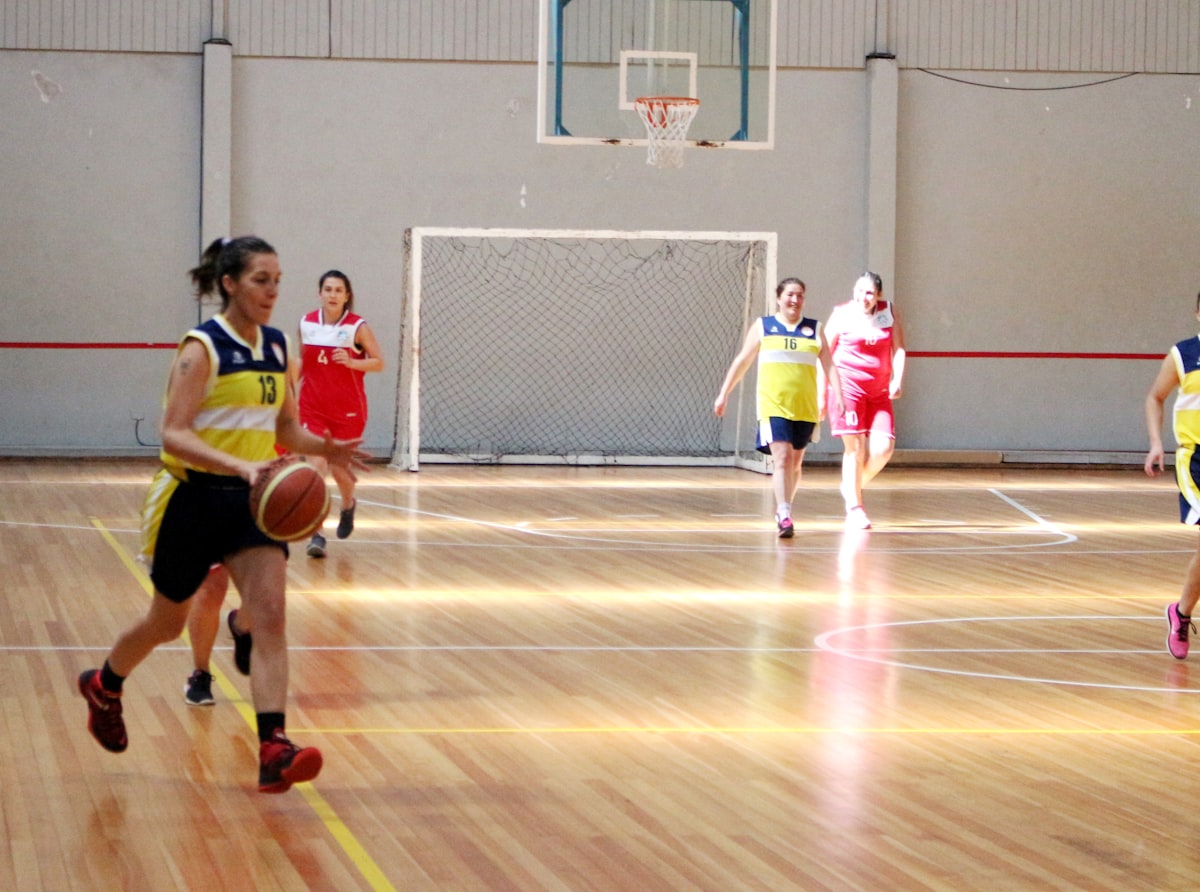
Learning how to improve basketball dribbling is less about performing flashy moves and more about controlling the ball under pressure. Effective dribblers keep their head up, change speed without losing balance, and protect the ball while moving toward a useful position on the court.
A good basketball dribbling workout should train control, coordination, footwork, pace changes, and decision-making. Repeating stationary crossovers can help beginners build confidence, but progress comes faster when those skills are connected to movement and realistic defensive pressure.
Build reliable ball control before adding advanced moves
Start with a stance that allows you to move immediately. Keep your knees bent, hips lowered, chest slightly forward, and feet separated for balance. Dribble with your fingertips rather than slapping the ball with your palm. Your wrist and forearm should control the ball, while your shoulders stay relaxed.
Use both hands from the beginning. Many players search for ways to improve their weak-hand dribbling, but the solution is consistent exposure rather than occasional practice. Spend at least half of each ball-handling session using your non-dominant hand. Begin at walking speed, then increase the pace only when the ball remains close to your body.
- Pound dribbles: Dribble forcefully beside your body for 20 to 30 seconds, keeping your hand over the ball.
- Low dribbles: Keep the ball below knee height while maintaining a stable stance.
- In-and-out dribbles: Move the ball toward the middle of your body and back without crossing it over.
- Front crossovers: Push the ball across your body and move your opposite foot with it.
- Between-the-legs transfers: Keep your hips low and receive the ball with the opposite hand.
- Behind-the-back control: Practice at a slow pace first, focusing on a clean catch rather than speed.
For every drill, keep the ball within a comfortable reach. If it travels too far away, your next action becomes a recovery rather than an attacking move. A controlled dribble is more valuable than a fast one that forces you to look down or stop moving.
Use your eyes, body, and pace to beat pressure
One of the biggest improvements in basketball ball handling comes from dribbling without watching the floor. Look at the defender’s chest, scan for teammates, and glance toward open space. Peripheral vision is enough to feel where the ball is once the basic movement becomes familiar.
Practice this progression: first dribble in place while looking forward, then walk across the court without looking down, and finally change direction around cones or floor markings. Add a partner who gives random instructions such as “left,” “right,” “stop,” or “change.” This turns a simple dribbling drill into a reaction exercise.
Changing speed is often more effective than performing a complicated crossover. Slow down to make the defender relax, then accelerate past the front foot. Use a hesitation dribble by briefly rising from your low stance, or use a sharp stop before pushing into a new direction. The movement should sell a possible attack, not merely display a ball-handling technique.
Your off-hand also protects the ball. Keep your non-dribbling arm bent naturally and use your shoulder and body position to create space. Do not extend your arm to push the defender. When turning away from pressure, place your body between the defender and the ball, then keep the dribble low and close.
A basketball dribbling workout that transfers to games
A useful 25-minute session can be divided into four sections:
- Five minutes of stationary control: Alternate strong-hand and weak-hand pound dribbles, low dribbles, crossovers, and between-the-legs transfers.
- Seven minutes of movement: Dribble up and back using changes of hand, direction, and speed. Keep your head up.
- Eight minutes of pressure work: Use cones, a chair, or a partner as a defender. Attack from different angles and finish each move with a controlled stop or pass.
- Five minutes of game actions: Combine a change of pace with a pull-up, drive, retreat dribble, or pass to an imagined teammate.
Rest briefly between sets, but avoid taking long breaks after every repetition. Game dribbling requires control while tired. At the same time, stop a drill if fatigue causes repeated mistakes in posture or technique. Poor repetitions teach poor habits.
Record a few repetitions from the side and from the front. Check whether your eyes are down, whether the ball rises above your waist during pressure dribbles, and whether your feet stay balanced during direction changes. Video often reveals problems that are difficult to feel while moving.
Common mistakes that slow dribbling progress
Practicing only the dominant hand creates a predictable weakness. Performing moves while standing upright makes it difficult to reproduce them against a defender. Moving the ball without moving your feet is another common problem: a crossover has little value if your body does not create a new driving lane.
Players also tend to rush advanced skills. Before adding spins or combination moves, make sure you can stop under control, protect the ball, and accelerate in either direction. In a real game, a simple crossover followed by a strong first step usually creates more space than a sequence of three poorly timed tricks.
Set a measurable target for each session, such as completing 50 weak-hand dribbles without looking down or making 20 clean direction changes through a cone course. Track turnovers during live play as well. Better dribbling should eventually produce fewer lost balls, stronger drives, and more time to see passing options.
Basketball dribbling FAQ
How long does it take to improve dribbling?
Many players notice better control after several focused sessions, but game-ready ball handling takes consistent practice over weeks and months. Short daily sessions are usually more productive than one exhausting workout each week.
Should I dribble with my eyes closed?
No. Basketball requires awareness of defenders, teammates, and space. Practice looking forward instead. The goal is to feel the ball through hand position and rhythm while keeping your vision available for the play.
What is the best drill for weak-hand dribbling?
Use a mixture of stationary pound dribbles, walking changes of direction, and live-pressure attacks. Stationary work develops comfort, while movement and defensive pressure teach you to use the weak hand when it matters.